Quantum phenomenon superfluorescence, a.k.a. an “optical bomb,” in perovskites opens the door to practical quantum technologies, such as sources of coherent quantum light operating at room temperatures. In a discovery that advances our understanding of quantum physics, an international team of researchers from École Polytechnique in France, the University of North Carolina, Duke University, and Boston University recently figured out why some materials are better at superfluorescence—a quantum phenomenon in which multiple excited emitters spontaneously synchronize their phases and emit a burst of coherent light. Quantum effects like entanglement that may accompany superfluorescence—except for ideal superradiant dynamics within the subspace of symmetric Dicke states—are extremely sensitive to external perturbations that cause it to quickly vanish. Very low temperatures enhance the phenomena, while high temperatures tend to do the opposite.
“Lead halide perovskites are crystalline semiconductors with a unique lattice structure and exceptional optoelectronic properties, which make them a promising platform to explore collective quantum effects,” says Vasily Temnov, a CNSR researcher at École Polytechnique’s Laboratoire des Solides Irradiés (Irradiated Solids Laboratory; LSI). Collective quantum effects
The team’s work was motivated by a central question for quantum optics: Can collective quantum phenomena like superfluorescence persist within disordered materials and at high temperatures? “Traditionally, such effects have been observed within specially prepared atomic systems or at cryogenic temperatures,” says Temnov. “We wanted to explore how interactions and disorder influence quantum coherence within solid-state systems.”
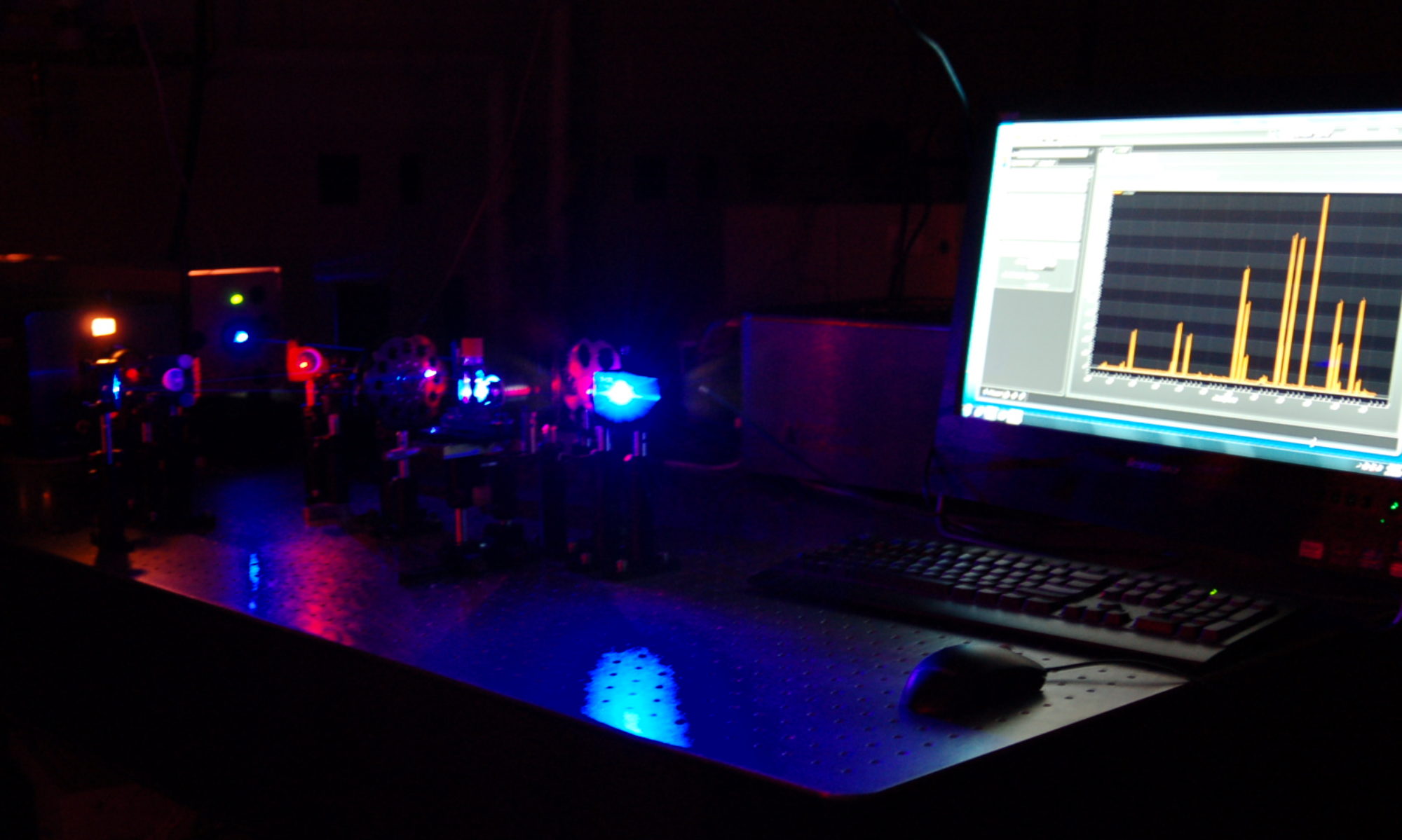
Experimentally, the team used time-resolved photoluminescence measurements to track the real-time evolution of a quantum phase transition from incoherent exciton-polarons (quasiparticle in condensed matter physics) to a collectively coherent state. And they used the Monte Carlo wave function method to simulate these dynamics based on a theoretical model that captured the main interactions of the system.
It revealed the stabilization of macroscopic quantum coherence within solids at elevated temperatures, which addresses a long-standing challenge for condensed matter physics.
“This opens the door to practical quantum technologies, such as sources of coherent quantum light operating at room temperatures,” says Temnov. “We show experimentally and theoretically that nonlinear exciton-lattice interactions can drive self-organization and coherence. For quantum materials and quantum computing, this reveals a new paradigm for engineering coherent phases and suggests promising routes toward scalable, thermally robust quantum emitters and lasers based on self-organized soliton phases.”
The team’s biggest “aha!” moment hit when they “realized that phonon-mediated interactions don’t just lead to dephasing but can actually promote ordering,” Temnov adds. “We first saw this in the experiment when superfluorescence persisted at high temperatures. It was unexpected, given the fast thermal dephasing.”
A closer look at the data showed fluctuations of superfluorescent intensity at frequencies matching certain phonon modes within these materials, which suggests that interactions with the lattice play an important role. “This led us to run Monte Carlo wave function simulations to understand the quantum dynamics of the system,” Temnov says. “Even after including disorder and fast thermal dephasing, the simulations showed that phonon-mediated interactions between excitons help protect the system from decoherence and allow superfluorescence to emerge at high temperatures. The coolest part for us was that we could capture all the relevant interactions in a simple Hamiltonian (a mathematical function to describe the total energy of the system), and that this model was able to reproduce the experimental results. It was very exciting to see.”
Laser Focus World