Laser Focus World Webinar. Explore how ultrafast imaging tools can track lattice dynamics and carrier behavior during critical material changes.
Roblonski platform made it to the news at R&D World
Roblonski platform automates photochemistry with 1,000-fold reduction in reagent use
By Julia Rock-Torcivia | April 24, 2026
Researchers from North Carolina State University have developed a compact, automated robotic platform for foundational photochemical assays. They call the system Roblonski, after A. Jablonski, who created the Jablonski diagram. They published their findings in ACS Central Science.
Here is the link: https://www.rdworldonline.com/roblonski-platform-automates-photochemistry-with-1000-fold-reduction-in-reagent-use/
Congratulation, Irene!
Irene Dzaye passed her PhD Final Oral Exam. The title of her Thesis was Photophysical Investigation of Chromium(III) and Related Polypyridyl Chromophores for Electron and Energy Transfer Applications. Congratulations, Irene! Well done! Congratulations to Irene’s advisor Professor Phil Castellano – this was his successful Ph.D. student Number 40!
Congratulations to Andre Moreira Nogueira!
On June 4 Andre defended his Ph.D. Dissertation titled Photoinduced Electron Spin Polarization of Stable Spin Centers using Ligand-to-Ligand Charge Transfer Chromophores. The work has been done under the direction of Prof. David Shultz but Andre also worked tirelessly in a close contact with IMAKS members developing a time resolved EPR setup.
Excellent job, Jon!
Jonathan Wheeler impressed the audience with his results and presentation and passed his PhD Final Oral Exam with flying colors on May 27, 2026 in TOX 2104. The title of his Dissertation is Tuning the Optoelectronic Properties of Cr(III) Diimines through Ligand Design. Well done, Jon!
A robust new telecom qubit in silicon
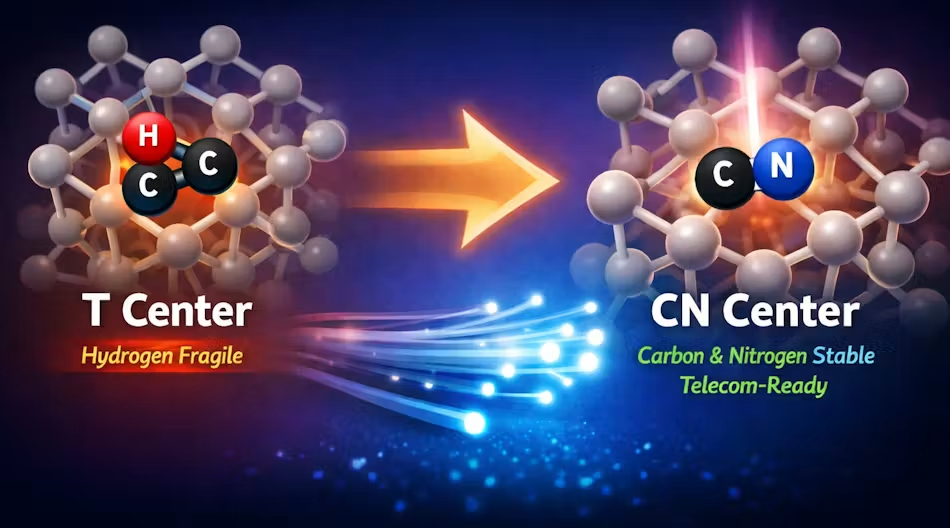
Newly discovered CN complex provides a more durable quantum defect that may accelerate advanced quantum technologies based on silicon. Qubits can be based on atomic-scale defects within a crystal. A prototype example is the nitrogen-vacancy (NV) center, which consists of a nitrogen (N) atom sitting next to a vacancy (V, a missing carbon atom) within a diamond crystal. These defects can interact with both electrons and light, which allows them to emit single photons (quanta of light) that can transmit quantum information or be processed in quantum networks.
Silicon has gained interest as a host material for defect qubits, because—unlike in the case of diamond—the mature fabrication and processing of silicon will allow scalable production of quantum computers and networks.
Sarah Kromer Wins the 2026 Robert A. Osteryoung Award for Research!
Over the course of her Ph.D., Sarah has worked extensively on projects focusing on the elucidation and manipulation of the photophysical properties of bi-platinum complexes showing unique coherent features on the time scales of single femtoseconds. Sara has also contributed to numerous collaborative research projects both nationwide and internationally.
Here is the email from Prof. Smirnova:
Dear Sarah
It is my pleasure to inform you that you have been named a recipient of the 2026 Robert A. Osteryoung Award in Research.
The Department will honor you at our Spring Graduation Ceremony on 05/08/2026.
Congratulations on this tremendous accomplishment! Thank you for your contributions to the Department of Chemistry and our community.
With best regards—
Tatyana I. Smirnova
Professor
Director of Graduate Programs
Department of Chemistry
North Carolina State University
Congratulations to Conor!
Congratulations Conor McCormick on graduating NCSU with your masters degree. We cannot wait to see what you do next! The title of his thesis was “Development and Characterization of Monodentate Rhenium(I) Photosensitizers”.
Roblonski made the most-read list in ACS Central Science
We made the most-read list in ACS Central Science!
Can quantum cascade lasers enable next-gen mid-infrared sensing?
Quantum cascade lasers (QCLs) are powerful mid-infrared (MIR) light sources for gas sensing, but factors such as manufacturing complexity, efficiency, system integration, and portability have limited their adoption for gas sensing systems so far. Optical gas sensing is widely used by industrial, environmental, and medical sectors where noncontact measurement, real-time response, and reliable operation are required. Applications such as process monitoring, emissions measurement, and respiratory gas analysis often involve complex gas mixtures and rapidly changing conditions, which demand sensors capable of both selectivity and sensitivity.
Many established optical sensing systems operate within the near-infrared (NIR) range (~0.83 to 1.55 µm), where efficient light sources and highly sensitive detectors are available.
Decades of development driven by the telecommunications industry led to reliable components—including indium gallium arsenide (InGaAs) detectors—that enable low-power operation and fast response times. But gas absorption features within the NIR spectrum are generally weaker and often lie close together spectrally, which can limit the ability to distinguish multiple gases within complex mixtures.
MIR (~3 to 11 µm) sensing addresses these limitations by targeting stronger and more distinct absorption bands. Although MIR technologies are less mature overall, the improved spectral separation available within this region supports more specific gas identification. QCLs provide a flexible and spectrally precise MIR light source, which enables direct access to narrow absorption features within a wide wavelength range and extends the applicability of MIR-based optical sensing to environments in which high measurement specificity is required.
Laser Focus World